Digital democracy, part 1: a party is only as democratic as the system that runs it
Party membership in Sweden fell from 14 to 6 percent while reporting duties keep growing. Part 1 of a series on why a complete system for members, votes and money is now a basic requirement for democracy inside a party, with cases from Sweden, Norway, Finland, Germany and Italy.
On Sunday 22 March 2026, Liberalerna held an extra party congress to decide whether Simona Mohamsson should continue as party leader. The meeting was digital, and it had to be paused at least four times because of technical problems. After three hours the delegates even voted on whether to stop the meeting altogether. In the end Mohamsson kept the leadership with 95 votes for and 80 blank. The day after, minister Lotta Edholm told TV4: "Det var fruktansvärt. Det var som att komma tillbaka till covidtiderna i början …" ("It was terrible. It was like going back to the early covid days …"), and added: "Det är helt oacceptabelt" ("It is completely unacceptable") (TV4, 23 March 2026). The reports don't say which part of the setup failed, so I won't guess. However, the result is clear: a decision about who leads a party in the Riksdag was taken in a meeting that its own delegates had voted on whether to abandon.
 Riksdagshuset in Stockholm. Photo: Leonhard Lenz, CC0, via Wikimedia Commons.
This is the first article in a series about digital democracy. My starting point is simple. In a world where almost everything has moved to digital tools, the democracy inside a political party depends on something most voters never see: a complete system for running the party. By that I mean one place where the member register, dues, branches, motions, delegate lists, internal votes and financial reports are connected. In my view, most parties don't have that today, and in this article I want to show what the absence costs and what having it would make possible.
Fewer members, more duties
The first thing to understand is that parties are being asked to do more with less. According to SOM-institutet at the University of Gothenburg, the share of Swedes aged 16 to 85 who are members of a political party fell from 14 percent in 1986 to 6 percent in 2025 (Svenska demokratitrender 1986-2025). Statistics Sweden measured the same trend and found that the share of active members halved, from 4 to 2 percent (SCB, 2018). Liberalerna's party secretary Jakob Olofsgård put it plainly when his party lost about 30 percent of its members in four years: "Vi måste lyssna på varför människor väljer att lämna …" ("We must listen to why people choose to leave …") (SVT, 13 October 2024).
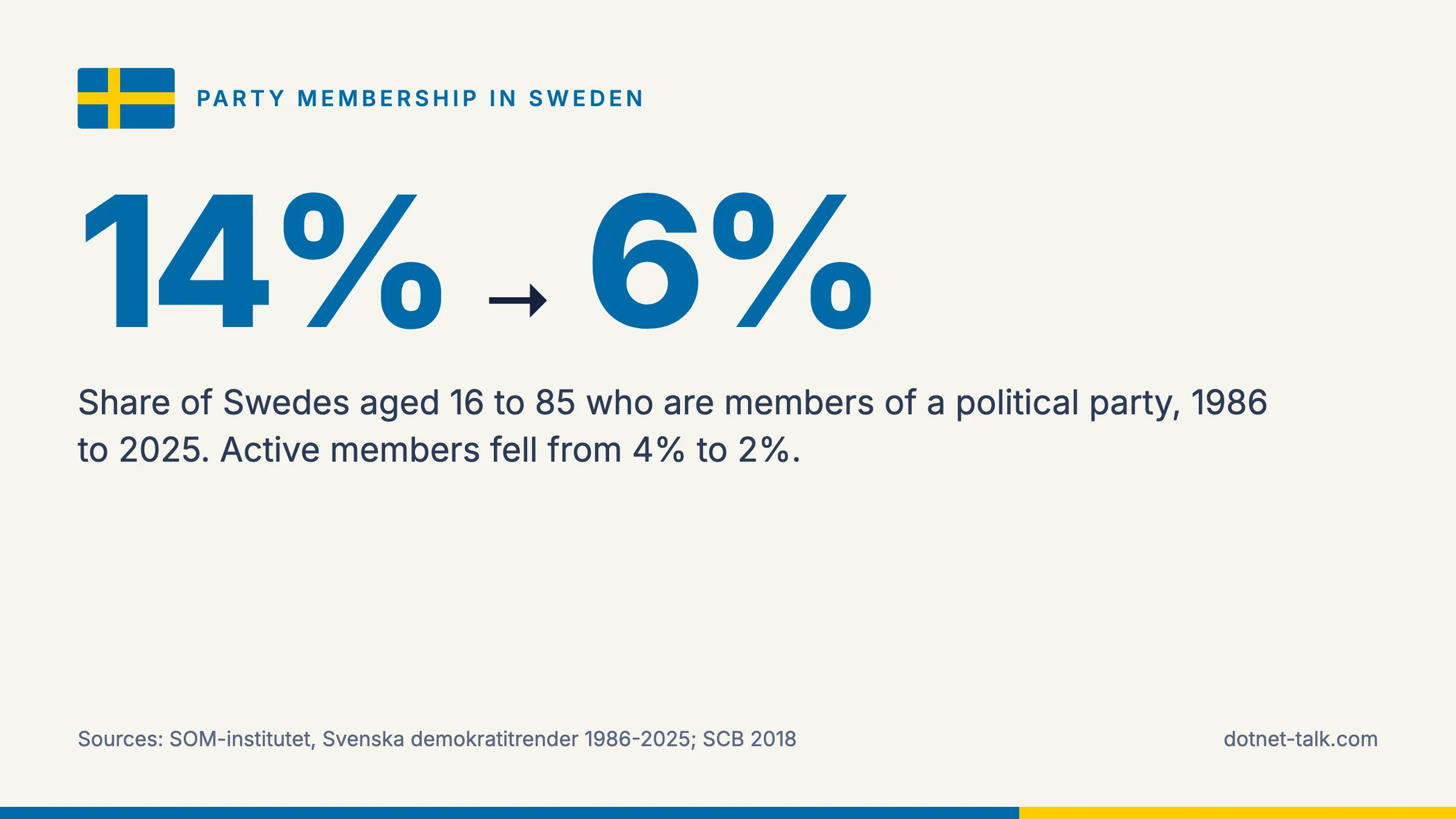 Sources: SOM-institutet, Svenska demokratitrender 1986-2025; SCB 2018.
At the same time, the legal duties keep growing. In Sweden, the law on transparency in party financing requires a party's central organisation, and every local association whose income passes a threshold, to report its income to Kammarkollegiet by 1 July the following year. Kammarkollegiet published 413 such reports in 2025, and it opens supervision cases, for example, when a report arrives after the deadline (Kammarkollegiet, Årsredovisning 2025). The amended law, which takes effect on 1 July 2027, goes further: anonymous contributions are banned outright (today only those above a small amount are), foreign contributions are banned apart from narrow exceptions, and from the 2028 reporting year the reports must also show costs, assets and liabilities (SFS 2026:1461). Already today, an electronic report has to carry an advanced electronic signature, a late report costs the central association 10,000 kronor, and an amount left out of the report can cost up to 100,000 kronor.
Norway shows what this looks like at scale. For the accounting year 2024, 3,226 party units had to report and 96.7 percent did. However, a presentation by the Norwegian authorities lists "adressemangler – mangelfull oppdatering i partiportalen" (address gaps because the party portal isn't kept up to date) and party units without any contact information at all. The number of notices for late contribution reports in an election year rose from 25 in 2021 to 56 in 2025 (KDD, November 2025). In short, smaller and more volunteer-driven organisations now carry a reporting duty that asks a lot of a volunteer treasurer.
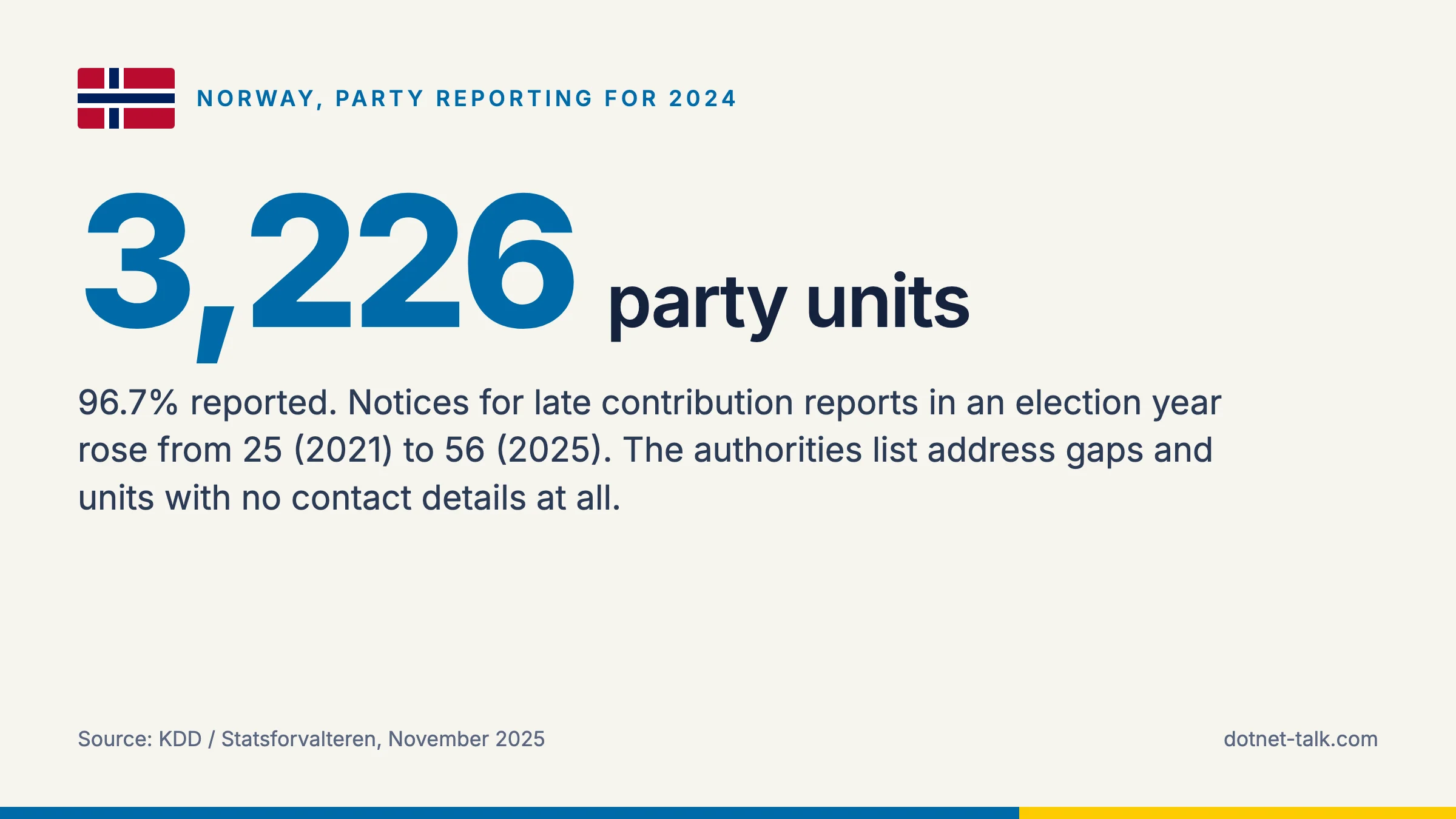 Source: KDD and Statsforvalteren, November 2025.
What goes wrong without a system
When there is no single system, the work doesn't disappear. Instead, it spreads across spreadsheets, separate apps and outside services, and the problems appear in three places.
The member data. Italy is the clearest example. The Five Star Movement ran its member register and its internal votes on a platform owned by a separate association. In 2019 the Italian data protection authority fined that setup 50,000 euros after finding, among other things, that authentication credentials were shared by several staff with high privileges, and that the platform "non gode delle proprietà richieste a un sistema di evoting" ("does not have the properties required of an e-voting system") (Garante, 4 April 2019). In 2021, after the party and the platform fell out, the authority had to order the platform to hand the member data back to the party, because the party was the controller (Garante, 1 June 2021). In Germany, a campaign app used by the CDU exposed data on about 18,500 volunteers and hundreds of thousands of door-to-door conversation records in 2021 (netzpolitik.org, 4 August 2021). Sweden has been here too, although longer ago: in 2012 the data protection authority found that the Social Democrats' central member register could be reached over an open network with only a username and password, and that it wasn't possible to find out who had accessed the data (Datainspektionen, 2012).
The vote. Liberalerna's congress is one example, and it's not the only one. In August 2022 the UK Conservative Party had to delay sending out the ballot papers in the leadership vote that chose the next Prime Minister, after advice from the National Cyber Security Centre. The plan to let members change their vote online was dropped, and ballots reached some of the roughly 160,000 members later than promised (Irish Times, 2 August 2022). When the voting tool is chosen in a hurry, the party ends up debating the tool instead of the decision.
The reporting. The Norwegian numbers above show the quieter version of the same problem. A late report is rarely about bad intentions. It's usually about a treasurer in a small branch who has the receipts in one place, the member list in another and no reminder at all.
What a complete system makes possible
The good news is that the opposite is already happening in several countries, and the results are measurable.
In April 2025, the German SPD let its members decide on the coalition agreement in an online-only vote. Of 358,000 eligible members, 56 percent took part (ZDF, 30 April 2025). In 2021 the CDU held its first member survey on the party chair, which the party congress then confirmed, and reached a turnout of 66 percent (taz, 17 December 2021). The German Party Act now also lets a party executive decide that votes in party bodies may be cast electronically, unless the statutes say otherwise, "unter Wahrung der Rechte aller Stimmberechtigten" (provided that the rights of all voters are protected), as long as security, including the protection of personal data, meets the state of the art (§ 15 (2a) PartG).
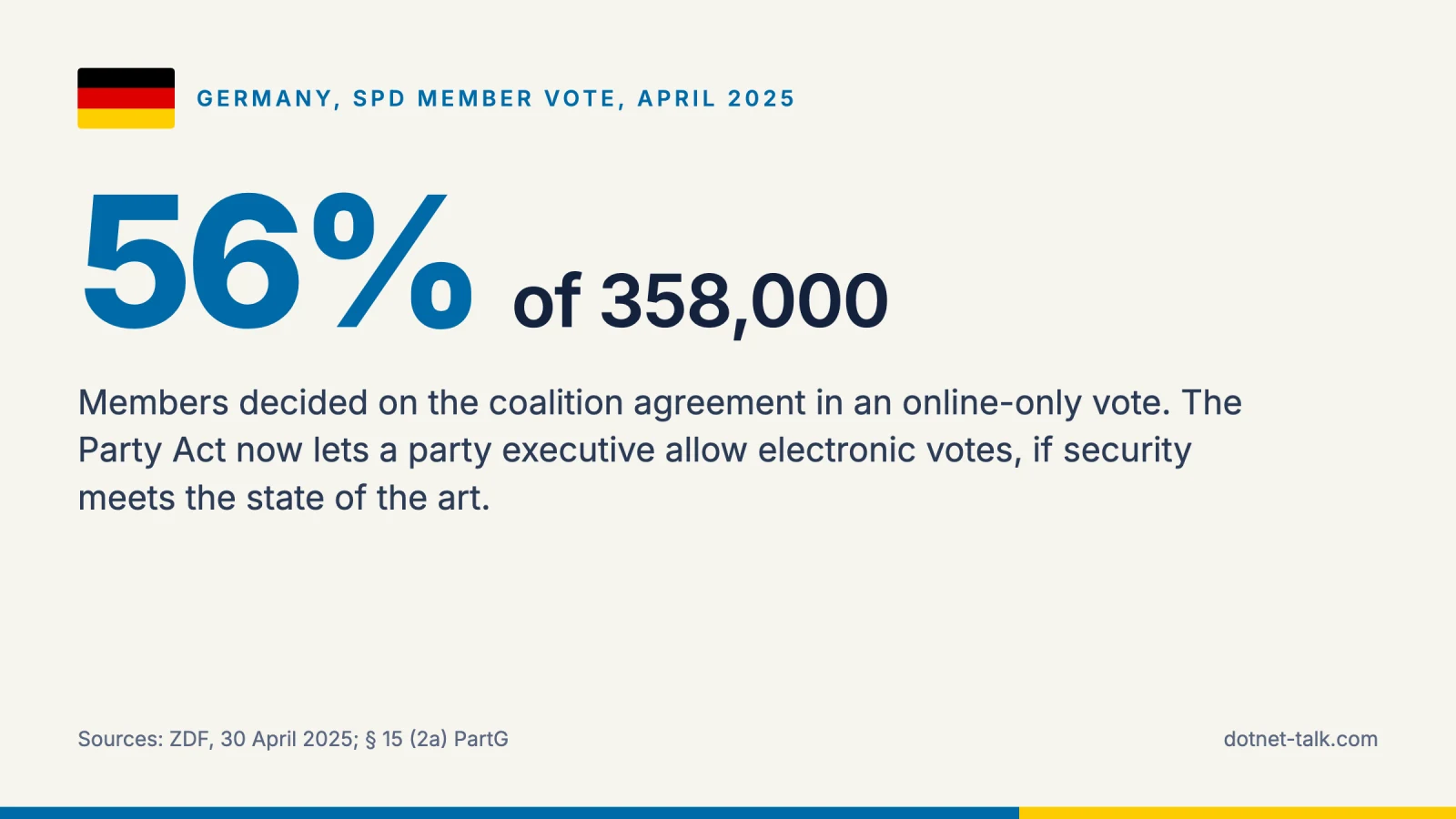 Sources: ZDF, 30 April 2025; § 15 (2a) PartG.
The Nordic countries have their own examples. In April 2021, Arbeiderpartiet in Norway held its national congress fully digitally, and written ballots were held "elektronisk med anonym avstemning i møtesystemet" (electronically with anonymous voting in the meeting system) (protocol, Arbeiderpartiet 2021). The most interesting detail, in my view, comes from Finland. The Social Democrats' rules for member votes in 2026 say: "Sähköisessä äänestyksessä käytetään puolueen jäsenrekisteriin liitettyä äänestysjärjestelmää" ("Electronic voting uses a voting system connected to the party's membership register"), and the right to vote is calculated from the register's data on a fixed date (SDP, 2025). That one sentence is the whole argument of this article. The vote is only as good as the register behind it, so the two have to be connected.
Research points in the same direction. A 2025 study of 22 parties in Spain, Italy, Portugal and Greece concluded that digital innovations "have indisputably driven greater participation among party members and supporters" (Sánchez Medero, Frontiers in Political Science, 2025), although the same study notes that decision-making power often stays with the leadership. International IDEA argued already in 2020 that online voting lets parties "make leadership more accountable to members", and it added that to do so, "the party needs a perfectly up-to-date and complete database of members" (International IDEA, 2020).
Three examples of what changes
To make this concrete, let's look at three everyday processes and what a connected system changes in each of them.
1. A member joins. Without a system, the form goes to one inbox, the payment to the bank, and the branch secretary hears about it weeks later, if at all. With a system, the member is registered once, the payment updates the same record, the member is placed in the right branch automatically, and the date that decides their right to vote is stored from day one.
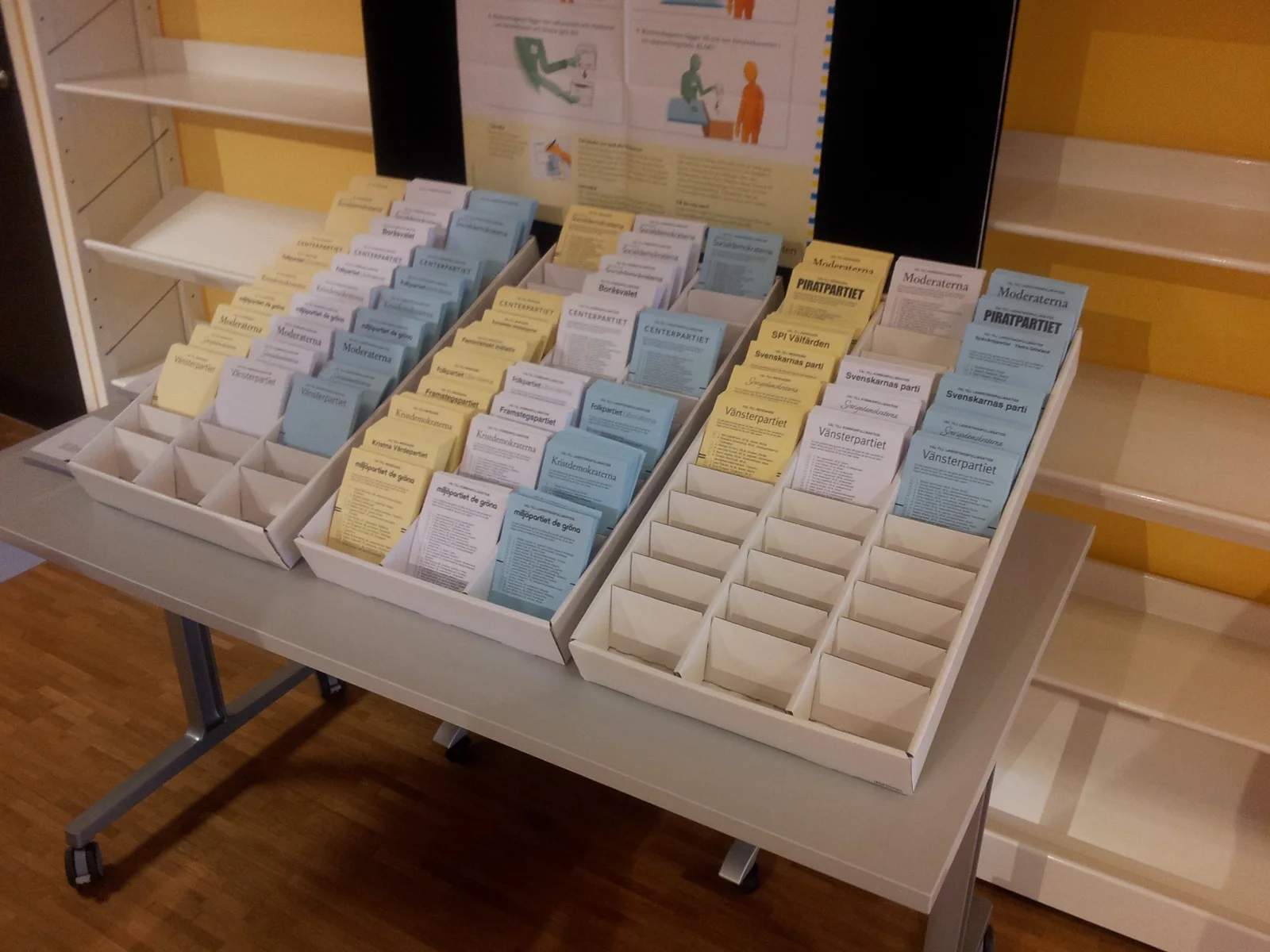 Ballot papers at a Swedish polling place, general election 2014. Photo: LevandeMänniska, CC BY-SA 4.0, via Wikimedia Commons.
2. A member vote. Without a system, someone builds the list of eligible voters by hand in the last days before the vote, and every mistake in that list can be used to question the result afterwards. With a system, the voter list is produced from the register on the cut-off date, each member gets one credential, the vote is secret, and the result can be checked without revealing how anyone voted. The Venice Commission also reminds us that direct member votes "may also disadvantage women, members of minority groups, or persons with disabilities unless some sort of correction mechanism has been provided for" (Venice Commission and OSCE/ODIHR, 2020). A system that knows the members can apply such corrections in the open, instead of by hand.
3. The annual financial report. Without a system, each branch treasurer collects receipts in their own way, and the central office chases dozens of reports in June. With a system, each branch records its income and, from the 2028 reporting year, its costs in the same structure, the central report is built from those records, and the signed report is ready before 1 July instead of after it.
The law already expects this
Finally, there's a legal reason why a party register can't just be a spreadsheet. Under the GDPR, data revealing a person's political opinions is a special category, and its processing is prohibited unless an exception applies (Article 9(1)). Article 9(2)(d) makes an exception for associations and other not-for-profit bodies with a political aim, parties included, but only for processing "carried out in the course of its legitimate activities with appropriate safeguards" and only as long as the data isn't disclosed outside the party without consent (GDPR, Article 9). In other words, the law accepts that a party has to know its members, and in return it asks the party to protect that knowledge properly. A member list copied into several files and sent by email is very hard to defend as "appropriate safeguards".
Where this series goes next
In my view, the question for parties is no longer whether to use digital tools, because they already do. The question is whether those tools form one system that members can trust, or a collection of separate pieces that only work until the next congress, the next leak or the next reporting deadline. In the next parts I'll look closer at the member register as sensitive data, at what a trustworthy digital vote needs, and at how the new Swedish reporting rules change the daily work of a branch treasurer.
If you have been the person who built the voter list the night before a congress, or the treasurer chasing receipts in June, what was the hardest part of it?
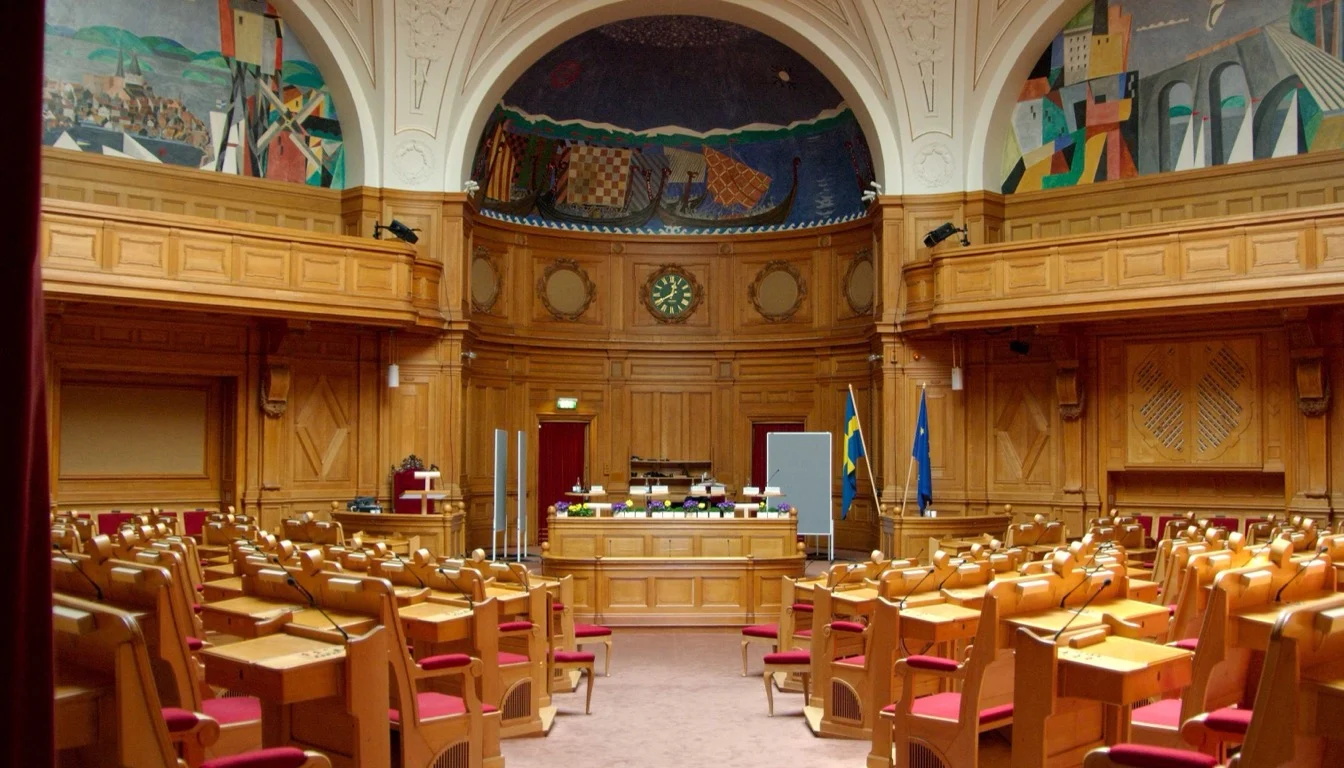
Cover photo: the Second Chamber hall of the Swedish Riksdag, by Janwikifoto, CC BY-SA 3.0, via Wikimedia Commons, cropped.

Sources
- TV4, 23 March 2026
- Svenska demokratitrender 1986-2025
- SCB, 2018
- SVT, 13 October 2024
- Kammarkollegiet, Årsredovisning 2025
- SFS 2026:1461
- KDD, November 2025
- Garante, 4 April 2019
- Garante, 1 June 2021
- netzpolitik.org, 4 August 2021
- Datainspektionen, 2012
- Irish Times, 2 August 2022
- ZDF, 30 April 2025
- taz, 17 December 2021
- § 15 (2a) PartG
- protocol, Arbeiderpartiet 2021
- SDP, 2025
- Sánchez Medero, Frontiers in Political Science, 2025
- International IDEA, 2020
- Venice Commission and OSCE/ODIHR, 2020
- GDPR, Article 9
Keep reading

November 3, 2026 · 8 min
10 November: What Actually Breaks When .NET 8 and In-Process Azure Functions Run Out of Support
.NET 8, .NET 9 and the Azure Functions in-process model all reach end of support on 10 November 2026. What is confirmed, what happens to running apps, how to find what you run, and the JSON attribute trap that fails without any error.
Read
October 29, 2026 · 8 min
Idempotent Bulk Ingestion into NebulaGraph from .NET: Solving the Duplicate Problem at the VID Level
Duplicates in a graph database are a key-design problem, not a row-uniqueness problem. This article shows how to engineer idempotency into NebulaGraph imports from .NET by controlling VIDs, edge ranks, and batch checkpointing.
Read
October 29, 2026 · 7 min
Graphs as Agent Memory: Why Vectors Alone Are Not Enough
Vector search tells your agent what looks similar; it cannot tell it what depends on what. This article shows concretely where embedding retrieval fails for dependency reasoning, then models a real service graph in NebulaGraph 3.7 with full C# wiring and traversal code.
Read